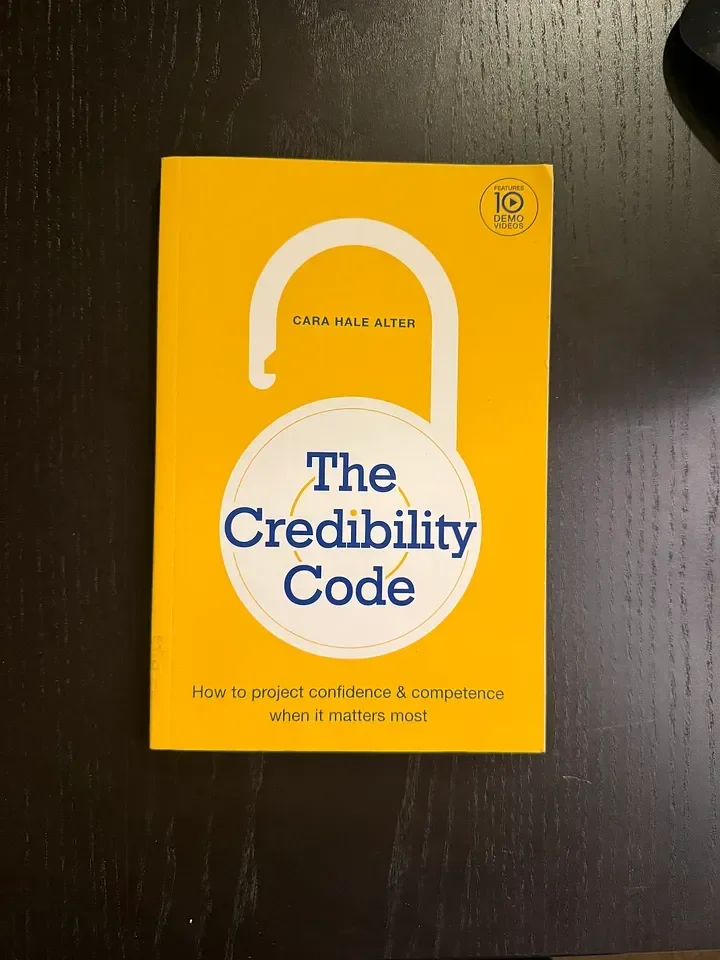
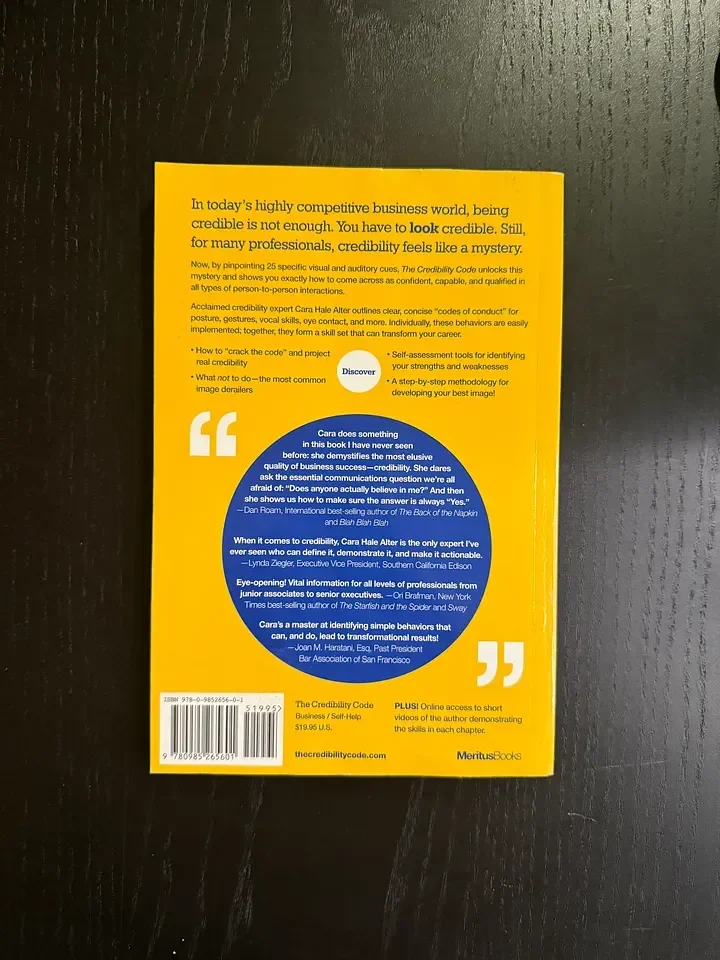
My Top 5 Takeaways from The Credibility Code by Cara Alter
Honestly this is definitely high up there in a frequently recommended book that I give to people struggling with public speaking in any kind of way. So it was so hard but I pushed through the pain to narrow things down to just my top 5. Here they are!
#5 Takeaway
Have you ever watch someone speak and they were extremely fidgety? It's like you want to tell them, can you please just be still. Be still!
I'll never forget I was watching someone speak and they kept rocking back and forth on the heels of their feet the entire time they spoke. I really thought they were about to do the cha cha real smooth at any moment.
Well unfortunately our nerves can highjack us at times to where we feel compelled to move to work off that nervous energy but it can definitely cause our credibility to take a hit. So in the Posture chapter of the Credibility Code, Cara gives a few tips.
One is when you need to change the direction of where you're looking, don't shift your shoulders or whole body, just your head and remember her 3-5 second rule about eye contact. Keeping the rest of your body still gives an authoritative presence.
Now of course you don't have to stay still in one spot the entire time. It's okay to move to a new location while speaking. It's just about when. Cara says you can move once for every paragraph you speak or when you're moving on to the next idea in your speech. Just be sure that your head is staying up and maintain eye contact.
There's nothing on the floor for you to look at…well except if there's cords. Be careful of cords and other obstacles but just don't become obsessed with them. But if you need a more concrete number rather than every paragraph, she suggests 45-60 seconds at a time you should move and not cha chaing every 2 seconds like the nervous speaker that I mentioned before. Keep that eye contact going and don't move your body too frequently.
#4 Takeaway
When I was coaching some interns last year, I remember that the biggest public speaking issue that many of them had was filler words. That's your "ums", "so", and "like", especially like. It's all too common of a struggle for many people regardless of age so don't assume that it's only younger people that struggle as there are older people that struggle with this too.
So Cara addresses this in The Derailers chapter of The Credibility Code. She shares about how it's really about slowing down. What you're doing is that your brain is trying to actively think and instead of just pausing to allow your brain a second or so to think, you use a filler word to buy yourself some time. But that in its place only cuts your credibility.
Remember that it’s okay to pause. Cara talks about how pausing actually makes you look more prepared and intelligent in conversation; that you actually are in command of yourself in the conversation. Pausing isn't going to make it awkward if it’s brief. Look at it as a way of giving your audience a moment to take in your message because if you're talking too fast with a bunch of filler words at that, people aren’t going to remember what you're saying anyway. It'll affect their retention of your message.
So I say as someone whose nervous tick is talking fast, slooooooow down. Pause. Smile. Speak (with projection). Avoid those filler words. And I highly recommend her book with this because she has some great exercises outlined for you to practice removing filler words. I did a few of them with one of my interns and it really helped her with her awareness of it to begin cutting it down in her speech. You gotta practice so practice in your day to day conversation so that you can get better at this when the pressure is really on.
#3 Takeaway
Your gestures in communication can say a lot about you and the relationship you have with your listeners. Cara digs into this within the Gestures chapter of the Credibility Code. It's good to use gestures when you're speaking as it makes you come across unguarded and comfortable talking with the person as if you already have an established relationship with them.
But when you don't have a connection yet, we tend to act that out in our body language. This looks like hands folded politely and hands that are very still where no one can the palms of your hands. Of course, if this is what you want is to be formal, then you will accomplish that by keeping your hands still. Just know that it risks you looking a bit self-conscious if you're talking but not gesturing. But if you're trying to engage and build relationship with the person, you want to come across as fluid and interactive. This is why you would gesture as you speak to the person.
Now of course don't overdo it as I have done unconsciously because of nerves as that can actually distract people from what you're saying. I've had the opposite habit of being so nervous that my gestures are all over the place so I'd say find that happy medium and the best way to do so is to record yourself or have a buddy that's willing to let you know if you look like a statue or telling you to stop directing the choir as one of my coaches early in my career use to tell me. Feedback is truly needed to effectively get better at this skill so don't be afraid to ask for it.
#2 Takeaway
You may have heard about having good posture but did you know that there's a difference in your posture for when you're speaking versus when you're listening to someone? Cara talks about this in the Posture chapter of the Credibility Code. By making slight changes in your posture you can make a person feel like you're engaged and receptive of what they have to share which is a way to use body language to build relationship with other people.
What this looks like is that you can relax your posture by rounding your spine ever so slightly or tilt your head a bit as you listen. Simple as that. People will feel like you're interested in listening to them. Hey go ahead and even add a slight smile and a head nod here or there.
But here's the problem, which is where things can get a little difficult. Remember that this is only for when you're listening. So when it's time for you to speak, you should switch back to straight spine and level head as you speak. Remember that this builds your credibility and helps you command the room. Listening posture is not for commanding a room so you don't want to get too comfortable into a listening posture that you can't switch it when it's your turn to speak.
My #1 Takeaway from the Credibility Code
I'm ending my takeaway countdown talking about the very thing that pulled me into reading this book in the first place. Most of my life, I did not speak loudly. I would get comments all the time to speak up or people couldn't hear me. I eventually got this book because when I started facilitating at work, these comments were more frequent.
I felt like Cara read me down in the Vocal Skills chapter of the Credibility Code. She said that how loudly you speak is often an indicator of how comfortable you feel. The more comfortable you feel, the louder your tend to be. Now this may seem like common sense to you but I had to realize that it wasn't that I just had a soft voice, but it was also that I was extremely nervous and felt a lot of imposter syndrome when I first started facilitating. So being able to acknowledge that was a first step for me.
Now luckily, Cara says that this is the easiest skill to work on as it's about your ability to speak louder and your willingness to speak louder, so for those of you that was like me, it's going to be okay. The thing is that when you speak, you should want to sound self-assured and confident. But when you speak too softly, you will come across as weak or soft.
So many times when people are struggling with this, their internal meter is off because they don't realistically know what volume they are at. You think you're talking loud or even yelling which is why you're not willing to talk louder but you're far from it. Cara even talks about how 1 of 5 people are soft speakers vs 1 in 200 are loud speakers when she analyzes her workshop attendees. So this means that this type of skill will definitely require getting feedback from others on how to best recognize your volume.
You have to work on not being afraid of sounding louder, or for some, messing up at a volume at where people can hear you. Use your diaphragm and practice building strength in your diaphragm so that speaking louder won't feel so much like a challenge. She has some great exercises in her book, but I really saw the value of asking coworkers to give me feedback after meetings of how well they could hear me so that I could start building a better perspective of my volume. Now do I still struggle with this at times, yes, but I've gotten a lot better and now I can adjust my volume the moment I sense it's off and stay at that level.
I really can’t say enough about how much this book has helped me in my speaking skills. So if you have read this book, I genuinely would love to know what takeaways stood out for you. If you haven’t read the book yet, tell me your thoughts about the takeaways that I’ve posted. (And check out my review to help you decide if this is truly the book for you.) I hope this has encouraged you to read the book if you haven't or that you've enjoyed hearing my takeaways from it if you have. Take care and happy reading!
