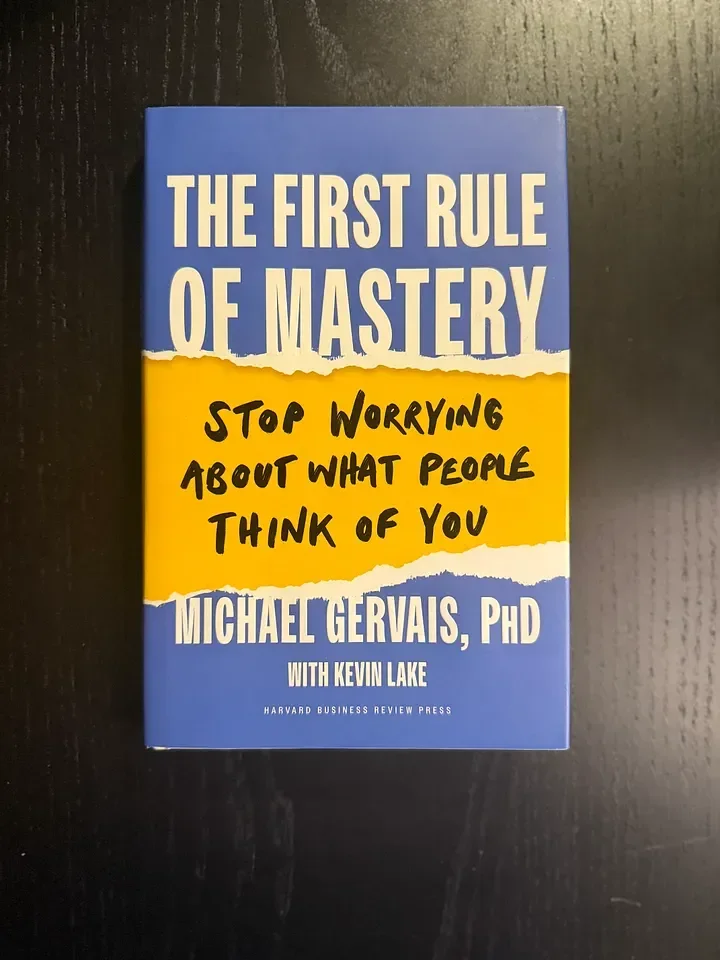
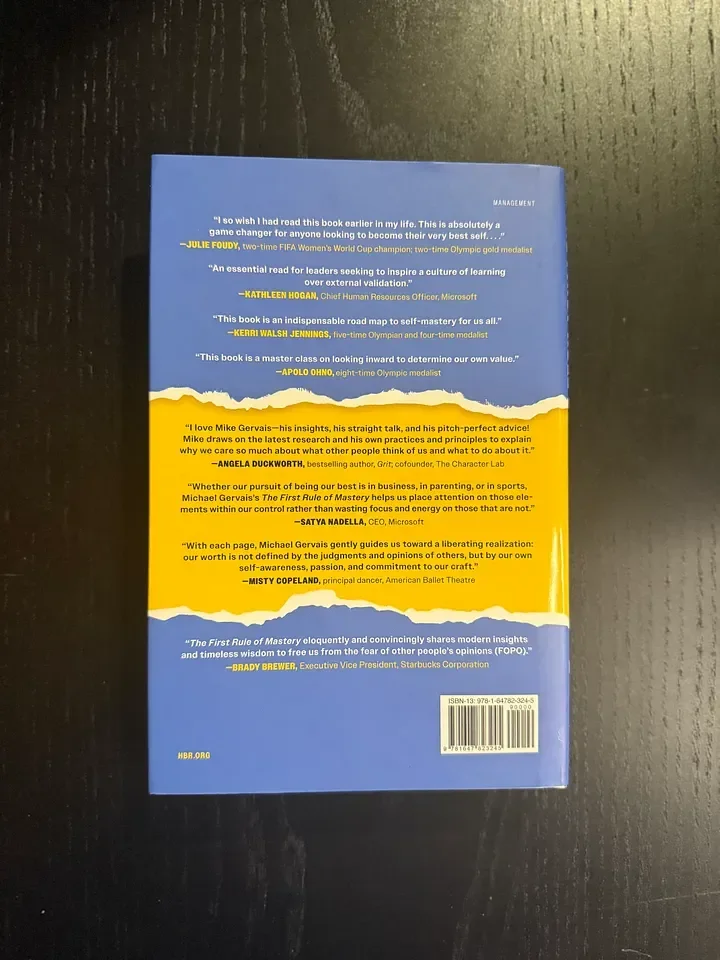
My Top 5 Takeaways from The First Rule of Mastery: Stop Worrying What Other People are Thinking of You by Michael Gervais
Who knew that a Harvard Business Review book recommendation would lead me to such an insightful read! Let me share with you my 5 takeaways that really stuck out to me from this book.
#5 Takeaway
In Ch. 4 of the First Rule of Mastery, Michael talks about the importance in having a purpose based identity. That being anchored in your purpose and being aware of the potential impact you can have will truly ground you to be more resilient in whatever life throws at you which includes the opinions of others. Your identity really becomes rooted in your core values and you use those core values to filter out opinions that are worth listening to and those that aren't.
Because don't get me wrong, feedback is a gift. You don't want to live in an echo chamber where you avoid any feedback that you don't agree with. Feedback is good. But it's about how you're filtering it to identify what truly should have the weight to influence your behavior. So we should all be working towards a purpose based identify. If you haven't taken the time to identify your core values, go google it now. This is a well known activity that many coaches do with their clients because of how foundational it truly is in becoming your best self. If you're curious my top 4 values are Authenticity, Fairness, Growth and Intentionality.
#4 Takeaway
I randomly got that song from Janet Jackson song Son of a Gun stuck in my head with this takeaway where she goes “I betcha think this song is about you don't you, don't you?” And it's funny because we can really be vain. We think that everyone is thinking about us when most of the time, you're not even crossing their mind. They're the ones that are actually living rent free in your head.
Well, Michael explains this in Ch. 7 of the First Rule of Mastery as the spotlight effect where we grossly overestimate how much people are paying attention to our actions and appearance. It's refered to as an egocentric bias that we're so focused on ourselves that we just assume others are doing the same about us.
And it's not to intentionally be self absorbed is what he cautions, but it's just that as he explains it "our worldview is a product of our own experiences and perspective and we attempt to understand other people's thoughts and actions through the same lens".
So don't nobody care about you, Otis! Okay they care, but it's more than likely that they are more overly concerned on focusing on themselves than you. So don't inflate their thoughts assuming that it's more than what it is to where you're giving it power to stop you from moving forward in your life.
#3 Takeaway
Have you ever disagreed with someone about something and they took it super personally? Like with the way they reacted it's as if you had called them out their name or something? So Michael shined a little bit of light on this in Ch. 11 of The First Rule of Mastery of why this is and it was really intriguing to me.
He says that usually it’s because that person has made that belief deeply personal to them so when it's challenged it actually activates the part of your brain that holds your personal identity. To your brain your deeply held personal beliefs and your identity are the same as they are held in the same location. And of course our brain is always trying to protect us, not only physically but physiologically as well. Now you can only imagine that this can cause a problem as you've probably seen in endless social media debates because people are completely unwilling to hear another perspective.
So now that you know that your brain can automatically do this it's important to actively be mindful of yourself to think, this person is not trying to attack me as a person. They just have a different view. Let me hear them out objectively just in case they have something to share that I've never thought of. Of course this takes a lot of maturity and disciplined in how you listen and communicate but it cane be done.
Michael gives advices of even taking time to reflect on your beliefs periodically to check if they are still serving you well or perhaps you need to adjust them because of the life changes you've endured. Are your current beliefs propelling you in life or are they limiting you when it comes to your purpose? Take that time to be reflect and be open to change if needed.
#2 Takeaway
I loved this advice that Michael gives in Ch. 12 of The First Rule of Mastery. He talks about how of course it's still good to get feedback so some people's opinions do matter. However what's key is that you are intentionally choosing the right people to speak into you.
So he shares about how you should create a roundtable as he calls it of people that you trust and know that they are committed to supporting you protecting you and having your back. That they are truly for you and have proved to be genuine people in your life that wants you to live and walk in your purpose and values. These are people that aren't afraid to be honest with you either and that you will always know that it comes from a good place when they give it. These are the people that should be in your roundtable to run any opinions that you receive to double check it before it has an influence in how you behave.
Because it's one thing to hear a fleeting opinion, but if you are hearing that same opinion from different people, it may be time to take it to your roundtable of people to hear their take on it before you do anything about it. By the way, just because he calls it a roundtable, that doesn't mean literal round table full of people. So yea no more than 10 people but really it can be just 2 or 4 people. He even encourages you to keep the list small anyway.
So really think, who are those authentic trustworthy people in your life and begin to lean on them so that you're not absorbing advice that shouldn't even be considered. I can think of a handful of people right now that I'm so thankful to have in my life because they have been honest with me. They have called me out before. But it's always in love and because they truly care about my well being.
I try to make sure I thank them for it whenever it happens because people don’t have to do anything for you. They don't have to be there for you. They don't have to care for you. They can keep watching you behave crazily and not say a word. So when you have people in your life that are authentically trying to be a good friend to you as they truly deep down want to see you win, hold on to those people. In fact go ahead and reach out to them today and say thank you because good friends are hard to come by.
My #1 Takeaway from The First Rule of Mastery
This takeaway made me pause. In Ch. 13 of The First Rule of Mastery, Michael shares this story about a woman that had a career as a caregiver that would tend to people in their last few months of life. She noticed a pattern that the number on thing that people regret in their life is not having the courage to live the life they dreamed to have where they lived in their values and truly had that purpose based identity. And the most common reason that they didn't was because they were afraid of what other people would think about them.
You know, it's crazy to think how much we limit ourselves. We really can be our own worst enemy by not only allowing those opinions to have power over our life but also by amplifying it in how we talk to ourselves. Our own monologues telling ourselves what we can or can't do. I can't imagine living life thinking I wish I would have just tried. Sometimes those opinions comes from our parents or our circle of friends or even just society and culture in general.
So I think that it is important that we recognize what's in our control. You can’t stop people from talking about you. But what's in our control is which opinions can have influence over us. And to help us stay humble but keep good boundaries, we can lean on our routable of friends to filter through them. We can think about our values to filter them. And overall from there we can make better decisions in how we evolve to being the person that God created us to be.
Those were my top 5 takeaways so what were yours? If you’ve read the book, please share what takeaways you had from it. If you haven’t read the book yet, tell me your thoughts about the takeaways that I’ve posted. (And check out my review to help you decide if this is truly the book for you.) I hope this has encouraged you to read the book if you haven't or that you've enjoyed hearing my take on it if you have. Take care and happy reading!
